|| Hari OM ||
|| ShrI guru sharaNam ||
Note: This article is an extraction of longer article, 'Hindu Dharma - the most organized, integrated spiritual and practical way of life'. The below title is the 12th title. To maintain similarity, here too we are starting the article with number 12 and not 1. The links of full article are:
12. yoga, haTha yoga, nAtha yoga, aghora, tantra and kriyA yoga
Let’s understand the basic difference between different types of yoga-s
12.1. yoga
The basic or classical text of yoga is ‘patanjali yoga sUtra’. There are other books like Siva sUtra-s, dattatraya sUtra-s. yoga is an ancient meditative technique however, wise say, it was maharShi patanjali who had complied basic principles of yoga into a systematic structure.
Many are of the opinion that the word ‘yoga’ means as some sort of physical exercise. However this definition is not true.
maharShi patanjali in his sUtra-s has defined yoga as ‘chitta-vritti-nirodha’. vritti means tendencies, behavior, or thoughts and desires. vritti is mental agitation that is caused while meditating.
The sUtra (aphorism) ‘chitta-vritti-nirodha’ means - yoga is to negate or remove tendencies of mind.
yoga also means ‘union’. Empirically it means meeting of two or more people or objects. Spiritually yoga means union of jIvAtmA (incarnated soul) and paramAtmA (The supreme consciousness, brahman). Merging of jIva in to paramAtmA results into enlightenment.
12.1.1. The path
Unlike popular belief that yoga includes practice of Asana-s (body postures), maharShi patanjali has not mentioned any Asana-s. Asana-s are found in manuals of haTha yoga. maharShi has just mentioned, ‘Sit in a posture that is comfortable’. yoga is control of mind and body via prANa (breathing) as, mind and breathing are connected. Later, mind is directly controlled. Any yogic process is not fully explained by books. They are to be learned only through an adept in yoga, a guru who has achieved mastery over mind. Still further, a yogi becomes aware of various subtle bodies and tatva-s. By tuning with them achieves mastery over them and then transcends them to rise above mAyA and merges in brahman resulting in enlightenment.
In this process, a yogi, according to the mental make-up and impressions of past lives achieves siddhi-s (super natural powers), maharShi patanjali cautions yogi-s against getting overwhelmed by siddhi-s as they cause hindrance to the spiritual progress.
Surrender to ISvara and having firm faith in him is also mentioned in yoga sUtra-s, though no particular form of Isvara is mentioned.
To a sAdhaka (meditator) this world is real, but for the siddha (Self Realised / God Realised), this world is unreal says patanjali in his sUtra P.Y.S. 2.22
Note: Here siddha means Atma siddha meaning God realised.
12.2. haTha yoga
haTha generally means ‘stubbornness’, here it means strict discipline. The most popular manual for haTha yoga is ‘haTha yoga pradipikA’. It is in haTha yoga that various Asana-s (body postures), bandha-s (blocking of subtle energy channels) and breathing patterns are mentioned. Though not compulsory, haTha yoga is generally taught to all neophyte yogi-s.
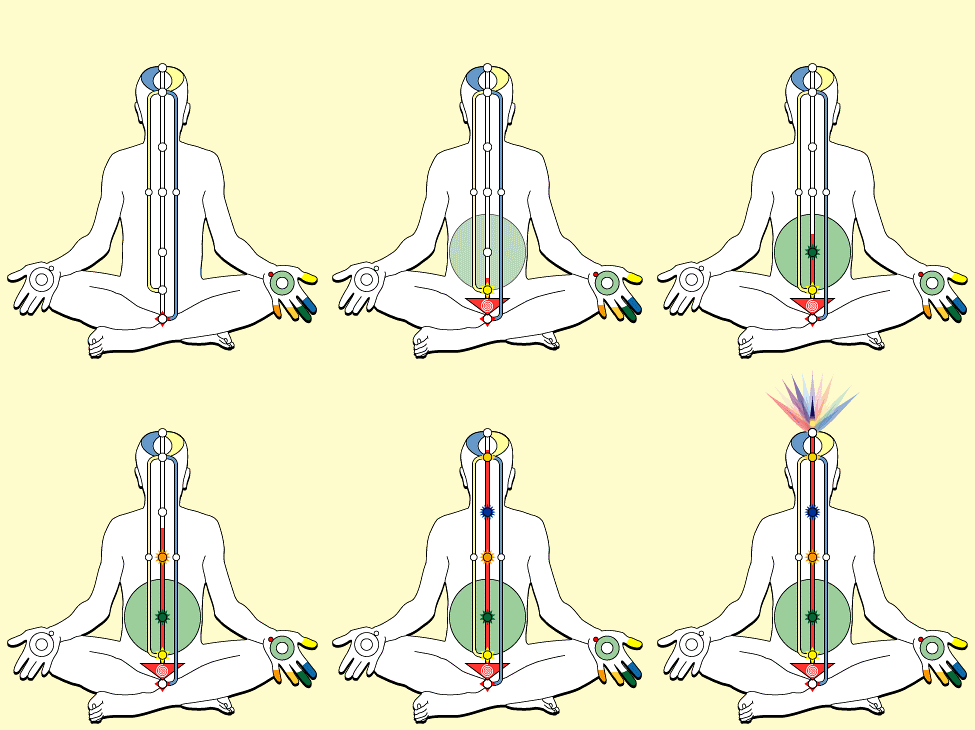
Asana-s and prANAyam-s help one’s body to become strong, healthy and disease free. It also helps cleanse nADI-s, activates chakra-s, cleanse subtle bodies, mostly it is prANamaya kosha (energy body / aura). It makes body ‘ready’ for meditation.
But before practising meditation, certain kriyA-s are practised. These are breathing techniques to cleanse subtle bodies and cleansing of chakra-s by directing energies. After the body becomes sufficiently pure, and mind calms down and turns introvert, meditation on supreme brahman is practised. The ways might be bhakti marga, GYAna marga (philosophical enquiry or meditation on OM) or kuNDalini yoga i.e. activating kuNDalini shakti from mulAdhAra chakra and raising her to sahasrAra chakra via three main nADI-s, initially through iDa & pingalA and later on through suShumNa. Subtle bodies, chakra-s, nADI-s and kuNDalini are explained later.
12.3. nAtha yoga, aghora yoga and tantra (Sakta, shakta)
nAtha yoga is an ancient yoga which was popularized by the great mahA siddha-s Guru maChChinder nAtha (also spelled as maChChindra nAtha, matsyendra nAtha) and his great disciple Guru gorakhanAtha (also known as gorakshanAtha). They are worshippers of Adi guru bhagavAn Siva. There are 9 mahA-siddha-s called as navanAtha-s (navnaths) and 84 siddha-s.
Guru gorakshanAtha had given to the world laya yoga, which is merging in brahman by tuning with the divine sound often heard in right ear like sound of damaru or flute. In general, it can be any mantra too. Mind merges (laya) into brahman by tracing the origin of these divine sounds. Sounds themselves establish yogi into samAdhi and thereby one realizes brahman (paramAtmA).
There are many works attributed to Guru goraksha nAtha / gorakh nAtha like gorakh bodh, gorakh shaTak but one of the most important work is siddha siddhAnta paddhati.
12.3.1. sAbara mantra-s - simplification of sanskrit mantra-s, grace of mahAdeva
The Legend, according to ShrI goraksha mahApurANa, a revered scripture of the order of nAth yogi-s which describes lives of 9 great nAtha-s of the tradition, says once Siva and Sakti were roaming and found one tAntrika chanting mantra-s that were formulated by Siva himself in a wrong way. Siva concluded that this tAntrika will be doomed. Adi Sakti, the compassionate mother blamed Siva for formulating such hard mantra-s and she said that Siva should give mantra-s in simpler form. Agreeing to Adi Sakti, Siva took form of aghori and went into the cave where tAntrika was chanting mantra-s in wrong way. He corrected him and gave him mantra-s in a simplified way. By chanting these mantra-s the tAntrika become a siddha and the first nAtha of the navanAtha sampradAya (‘nav’ means nine). These mantra-s came to be known a shAbara mantra-s. shAbara mantra-s are not in sanskrit. Many are in Hindi or it’s dialects.
Unfortunately, by the passage of time, due to selfish nature of human beings, these mantra-s were corrupted. Indians must have seen a fakir or a beggar who roams door-to-door with a dhoop (incense releasing lots of smoke) and waves peacock feathered broom chanting weird mantra-s. These are corrupted form of shAbara mantra-s. Originally, these mantra-s were used as an act of compassion by the siddha-s and nAtha yogi-s for the good of all. There are mantra-s to ward off evil effects, mantra-s for protection and well being of all, mantra-s for removing poison injected by scorpion bite (also found in atharva veda), and so on. gosvAmI tulsidAsa has also glorified sAbara mantra-s in one of his chaupai (four line verses in avadhi, a dialect of Hindi)
अनमिल आखर अरथ न जापू ।
प्रगट प्रताप महेस प्रतापू ।।
कलि बिलोकि जगहितहर गिरिजा ।
साबर मंत्र जाल जिन सिरिजा ।।
chaupai says, that for the good of mankind, maheSa (Siva), gave Sabara mantra-s.
An example of correct SAbara mantra is
Mantra for healing the wound
सार-सार बिजैसार बांधूं सात बार, फुटे अन्न उपजे घाव, सार राखे श्री गोरखनाथ ।
This mantra is to be chanted 31 times and then one has to blow air on the wound. It is expected that the pain should vanish and wound begins to heal.
Credits: The above mantra-s are listed by Tantrik Bahal, Page 370 in Goraksha Mahapurana. TAntrik Bahal worked hard for years to find correct SAbara mantra-s.
(Note: Many may not agree with such practices and may discard them as primitive, nevertheless, we thought tthese mantra-s should be displayed not with the aim of practising, but just to get an idea of the nature of SAbara mantra-s)
It is to be noted that one may not find any effect of these mantra-s if one tries it. We are not nAtha yogI-s nor were we initiated into nAtha sampradAya. The mantra-s are displayed only for educational purposes for getting a feel of nature of SAbara mantra-s.
SAbara mantra-s were meant to ward off evil influence, evil spirits and bad fortune. In addition to these, there are mantra-s to relieve pain in tooth, eyes or in general body pain, to cure diseases, heal wounds, removing of poison, protecting the womb, vashikaraNa (controlling the mind of another person), etc.
Fortunately, there are some yogi-s who have protected the real mantra-s and are engaged in the spiritual quest for Self Realization. They rarely use these mantra-s, as they are not central part of yogic kriyA-s. Rightly, these true nAtha yogi-s stay away from society and live in isolated places life jungles.
SAbara mantra-s cannot be practised by anybody. The basic principle is - Energy Follows Thoughts. Energy forms a particular shape in manomaya kosha (mental body). More concrete and clear the thought, better is the shape of thoughts. As the person raises his / her consciousness and progresses in spirituality, s/he can generate more powerful thoughts. These thoughts are then directed towards the target which they reach and then make our wish to manifest.
So the process of chanting mantra can be divided into two parts
Creating a thought or an idea or a wish
Directing it to it’s target
The in between part can be energizing the thought. This can be done by repeating the thoughts or chanting certain mantra-s or simply passing the energy in them. This is a complex science and a yogI is cautioned not to practice without getting initiated, as a guru is necessary to cover your mistakes and imperfections while chanting the mantra or directing them. Hence it is strongly recommended NOT to practice them even though they look simple.
These mantra-s are first to be mastered. A nAtha yogI must be initiated by another nAtha yogI, who is an adept in such practises and also is an enlightened master.
12.4. The philosophy of nAtha yoga
SAbara mantra-s do not form the core of nAtha philosophy. The path of a nAtha yogI is an inner journey, a kind of inner engineering, the end of practicing results in controls of 5 elements (air, water, etc) and transformation of body into light body, creation of indestructible spiritual body. This achievement is called as pinDa siddhi
The philosophy of nAtha yoga is similar to Kashmir Saivism. Though a dualist school, it ends in non-duality. Brahman of the upanishads is referred to as Siva or para sAmbit, or para bhairava. Siva and Sakti are inseparable. Siva cannot do anything without Sakti. Sakti is the dynamic potency of Siva. The world is considered as real and as an extension of Siva himself via his potency, Sakti. Siva who is unchanging and formless and Sakti, the dynamic power interpenetrate each other. This ultimate state is called as sAmrasya. This is something different than sAnkhya and vedAnta which says that the reality is untouched by prakriti and one has to transcend or sublate prakriti (mAyA) to experience it. The path of nAtha yoga is not only to experience this non-dual state, but to permanently stay in it without ever coming down to the dual plane. The process involves strengthening of physical body and the subtle bodies, activating chakra-s and raising kunDAlini to sahasrAra. Intense yogic practises are taught to selected few which result into transformation of our body into indestructible spiritual body. In the process, a nAtha yogI comes across many siddhi-s, masters them and proceeds further. nAtha yogI, may also experience and, in his subtle body, even enter into subtle higher worlds like Indra-s heaven or even go to nether world by his own wish and return back to earthly plane and return to his physical body. After achieving perfection, a nAtha yogI roams the world for the good of mankind spreading peace and Siva’s grace on all, enjoying the play of Siva-Sakti. nAth yogI also experiences and explores the relation between microcosm and macrocosm and the effect on each other. Every microcosmic event has it’s reflection in macrocosm and vice versa. A nAtha yogI is in constant communion with Siva, the supreme reality.
There are differences between the yogic schools of patanjalI, kriyA yoga and tantrika buddhism.
After understanding nAtha yoga, lets understand who are aghori-s.
12.5. aghori-s
aghori-s are branch of nAtha yogi-s. They are worshippers of Siva. During course of time, many nAtha yogi-s began teaching yoga in their own way and in process they ended up creating their own sects. gorakhnAtha in order to distinguish themselves from other nAtha yogi-s made piercing ears compulsory as a distinguishing mark. nAtha yogi-s generally wear ear rings. Since their ears are pierced, they are called as ‘kan-phaTA yogi-s’ (Kanphata Yogis). ‘kan’ or ‘kAna’ means ear and phADanA means to tear or pierce. phaTA means torn or pierced. Hence kan-phaTA yogi-s would translate as ‘Yogis with pierced ears’.
Aghori-s do not pierce their ears. Every nAtha yogI is an aghori before piercing his ears. matsyendranAtha and gorakhanAtha pierced their ears and hence they were known as kanphaTA yogI-s while jAlandharanAtha remained aghori for the life time (as he didnt pierced his ears and wore earrings).
Among sub-sects of aghori-s, aughaDa (औघड), sarvaMgI (सर्वंगी) and dhurai (धुरै) (pronounced dhurei) are known. Most of the information that is written about aghori-s is that of aughaDa-s. aughaDa-s by nature are angry. Due to this reason, common people stay away from them as the common perception is that if they are displeased and get angry, they are capable of destroying their futures and bring in bad fortunes. Hence whenever they beg for alms, they re not allowed to leave empty handed. However, the reason of their anger is to keep away people for mainly two reasons - (1) to stay in solitude and (2) to keep secret meditative procedures secret so as to avoid the danger of them falling in wrong hands. They do not intend to harm people. Anger is constructive used, as it is like fire which can give life (cook food and give warmth) or give death (burn to ashes). It all depends upon how the fire of anger is used.
aghori-s are like kapAlikA-s. They achieve siddhi-s and are believed to use them for the good of all. aghori-s live in cremation grounds, as they can get all their requirements from cremation grounds. They are not allowed to have any connection with their family or with society. They do not have their homes. They eat anything fresh or rotten, animal and human flesh, as they believe that, ‘nothing exists which is not Siva’. Hence there is nothing like ‘good’ and ‘bad’, ‘permissible’ and ‘forbidden’. aghori-s take this philosophy to extreme. For them, veg or non-veg is just a matter. A dead animal body and a dead human body are one and the same Whatever we eat, finally becomes blood. A person requires very strong mind to follow the path of aghori-s. They do not represent mainstream Hinduism and are not interested much in veda-s.
aghora means that which is not ghora i.e. that which, lacks fear or that which is not terrific. aghori-s are taught to detach themselves to the processes they do, especially those which are considered as taboo and by the grace of guru and Siva, they are themselves not affected by them. they are masters of energy and kuNDalini. A famous aghori kenArama was believed to have powers to control 5 principle elements like air, water, fire, etc. They use their powers for good of humanity. However these sects are the most feared one by society and no one wishes to mess with them.
True aghori-s never does evil on others and are always immersed in meditation on Siva. True aghori-s are ‘inner scientists’.
12.5.1. nAgA sAdhu-s are not aghori-s
nAgA sAdhu-s are different than aghori-s. The difference is in their spiritual practice. nAgA sAdhu-s follow traditional vedAnta. They are ardent practitioners of haTha yoga. nAgA-s do not eat rotten flesh or human flesh. nAgA-s follow their own rules which were set up by great sankarAcArya-s like madhusudan sarasvatI. aghorI-s roam anywhere and live in cremation ground, whereas nAgA-s live collectively in their akhADA-s. Few roam in the outside world. While living outside their akhADA-s, they are forbidden to roam completely naked. They have to wear 3.5 meter cloth as SishTAcAra (good moral conduct as expected by the society) is necessary when they are roaming in society.
Birth of nAgA-s was to provide military assistance to kings. They are Hindu martial monks trained in combat skills, Guerrilla warfare, fighting in open, conducting surprise raids on enemies and fighting in extreme conditions like desert or in cold weather himAlaya-s. aghorI-s are not martial monks, though nAtha yogI-s also practice martial arts, the very purpose of creation of nAgA sAdhU-s was to defend the attacks on sanAtana dharma in 14-15 century. There may be martial monks prior to madhusudan sarasvatI, but may be they were scattered, it was madhusudan sarasvatI who is credited to bring them under one roof and give a definite structure to their way of life.
Life of nAgA sAdhu-s is discussed later.
12.6. tAntrika-s (Sakta-s)
While aghori-s and nAtha-s are worshippers of Siva, tAntrika-s are the worshippers of SAkti. They consider Adi Sakti as Brahman and all Gods and avatAra-s comes under her sway.
The most popular and also the most difficult tAntrika sAdhanA is ‘SrI vidyA upAsanA’. It is said that only a handful of people (around 12-14) in entire world, all living in India, have full knowledge of SrI vidyA and SrI yantra. SvAmI brahmAnanda of jyotir maTha (also known as joShI maTha) was considered as an authority on SrI vidyA upAsanA.
A yantra is used as it is difficult for new practioners to directly meditate on chakra-s, kunDalini, and perform intense tAntrika practice.
12.7. Saivism - vedic and yogic (tAntrika, Agamic)
Saiva-s are the devotees who worship Siva as the Supreme Brahman.. There were many prominent Saiva (shaiva) saints from bhakta-s (nAyanAra-s, Nayanars) to vedic (SrikAntAcArya) to Agamic / tAntrika (Abhinavagupta of Kashmir Shaivism). AcArya-s of Saiva order are called as either ‘SaivAcArya’ or ‘SivAcArya’. Those having mastery over Saiva Agama-s and engaged in either teaching Saiva Agama-s or practising procedures of temple worship, according to Saiva Agama-s are called as AgamAcArya or Siva yogI. Siva yogi-s are the temple priests of Siva temple.
Though Saivism has its support in veda-s, most of the Saiva-s adhere to 28 Agama shAstra-s. There are independent works like thirumandiram and Kural. siddhAnta Saiva-s have extensively dependent upon thirumandiram written by a great siddha, thirumulAra (Thirumoolar, Thirumular). The legend says he wrote one verse every 1 year when he descend from samAdhi only for one day during the whole year. Thirumandiram contains more than 3000 sUtra-s of yogic-devotional genre. Unlike patanjali’s yoga sUtra-s asks yogi to believe in ISvara, but does not specify the form of ISvara, Thirumandiram contains verses devoted to glorifying Siva.
Kashmir Shaivism of SrI Abhinavgupta (AG) is also called as kaula or trikA or spandan kArikA. AG has written a masterly treatise on tantra by the name tantraloka, a mystical, cryptic texts containing more than 55000 verses suited for practising advanced tAntrika-s. AG has also written a commentary on it. This unique Acharya has given 3 different interpretations of same verse which are experienced by tAntrika-s and yogi-s who has raised their consciousness to that particular level. Only a practising tAnrika can actually understand tantraloka.
It was AB who had given the now popular symbolic interpretation of the battle of kurukshetra, mahAbhArata, in his gItA commentary ‘gItArtha samgrah’. Acharya has defined kurukshetra as ‘mind’, pANDava-s (Pandavs) as positive divine qualities and kaurava-s as negative qualities. It is the war inside every one of us.
Agama-s are called as tantra-s. There are Agama-s for Saiva-s, Sakta-s and vaiShNava-s. Though vaiShNava-s have adopted pure bhakti to reach the supreme Godhead, there are vaiShNava Agama-s which talk about chakra-s. Saiva-s and Sakta-s.
Conventionally, Saiva-s though they adhere to Agama-s (tantra-s) are simply called as Saiva-s, Sakta-s ar called tAntrika and nAtha yogi-s are called as ‘nATha-s’.
It must be mentioned that there are vaiShNava-s who also practice tantra. Not much is known about them. They prefer to practice in secret.
12.8. kriyA yoga
kriyA yoga is an ancient yoga, revived by a deathless saint Mahavatar Babaji, an immortal yoga, who initiated some great yogi-s like Lahiri Mahashay, considered as ‘fountainhead of Kriya Yoga’. There are great yogi-s like Yukteshwar Giri Paramhansa Yogananda, Sanyal Mahashay, Paramhansa Hariharananda and his disciple Paramhansa Prajnanananda (paramahansa praGYAnanda, परमंहन्स प्रज्ञानन्द).
Mahavatar Babaji - An immortal Saint
It will not be off topic to describe about a shining example of kriyA yoga, the survivor and revivalist of kriyA yoga Mahavatar Babaji. Babaji denotes respect in Indian language. Mahavatar means the great avatar. Marshall Govindan in his book, ‘Babaji and the 8 Siddha Kriya Yoga Tradition’ writes that Mahavatar Babaji controls and directs the activities of avatars of siddha-s.
Mahavatar Babaji is said to have transformed his physical body into light body and achieve immortality. He is believed to be more than 1800 years old. Mahavatar Babaji or Nagaraj (his childhood name) practised intense meditations and did a penance for many months so as to have the great rishi agastya as his guru. Finally agastya rishi appeared in front of him and taught him advanced kriyA-s and yogic practices which he was told to practice in himalayas as the energy generated due to these processes would be too much to handle by the people living in vicinity. At the age of 16, Mahavatar Babaji says that Siva mae his physical body immortal i.e. Siva freezed the life of his physical body. Babaji says, ‘Siva never made me 17’. His physical body stopped aged any further making Babaji to remain eternally youth. He then continued his spiritual practice to successfully transform his physical body into light body. Babaji wished to leave his spiritual body, but upon intervention of his sister, who herself is a great kriyA yogI, he decided to stay till earth exists and help souls ready to progress on spiritual path.
Mahavatar Babaji was introduced to this world by Paramhansa Yogananda, an exponent to Kriya Yoga and founder of Divine Life Society in his autobiography, ‘Autobiography of a Yogi’.
Let’s understand the meaning of the word ‘kriyA yoga’ as said by masters themselves.
12.8.1. ‘kri’ and ‘yA’
Generally kriyA is understood as ‘action’, but kriyA yogi-s explain the word kriyA as kri+yA as kri = action and yA = (indwelling) soul. yoga means ‘to unite’.
We, incarnated soul / jIva / jIvAtmA are separated from the Supreme Self (Cosmic Self / God / Brahman / paramAtmA) and trapped in the cycle of birth and death. Our journey, a jIvAtmA is to return back to the original source of our creation, paramAtmA.
Hence kriyA yoga could mean the journey of incarnated soul back to it’s source and merge in it.
Initially, mind is not prepared to meditate on the Supreme Self. Hence it must be purified. Breath, mind and body and interconnected. Breathing and physical heart are also connected. Calmer the breath, slower and rythmic is the pulse, faster and shorter the breath, faster is the pulse. Both heartbeat (and so pulse) and breath are with us from birth till death. But getting hold of heartbeat and controlling it is not very easy. Breathing is easy to feel and control. Hence in yoga, breathing exercises called as prANAyam and later on energy based kriyA-s are taught. They help yogi to calm mind and purity mind, gross and subtle bodies. Mind cannot stay without work. Hence kriyA-s help one to achieve concentration and purity. They directly do not lead a yogi to ultimate state. Until one gets sufficient purity to hear inner sound, or the cosmic divine sound OM and find the source or one can be aware of the entire yogic process like being aware of kuNDalini, chakra-s and subtle bodies and observing the whole working of this cluster of mind-body as a witness, one has to do kriyA-s. Later through the grace of God and Guru and through the power of discrimination, dispassion and ability to be a witness of everything that is going around, one can merge into paramAtmA. kriyA-s help cleanse and integrate bodies, synchronize them, remove blockages in subtle energy channels (nADI-s) and chakra-s. Being witness and trying to find the source of breath, thoughts and the mantra OM, one can unite with paramAtmA. This is the common approach of yoga schools.
Here is the definition of the word kriya yoga given on website of Kriya Yoga
Kri and Ya
The word Yoga comes from the root yuj. It has 32 meanings in Sanskrit, but the most appropriate here is to unite. The union of the individual Self with the Cosmic Self, the child of God with God, the Father. Therefore, the body with the Soul is Yoga.
Kriya Yoga is a supreme science of Self-realisation. It is a scientific technique of action with constant God-consciousness, which ultimately leads to realisation - going beyond the body, mind, intellect, thought, and even the world, to Soul-consciousness.
To perceive the Soul in every breath, in every moment, in every action, in everything and every being is Kriya Yoga. By the practice of Kriya Yoga meditation, one aspires to lead a life of divine consciousness, which ultimately brings love, purity and joy.
“You are to reach God in two steps, kri and ya.
Remain concentrated at the top and observe your own work from morning till you go to bed”
"Meditation is the silent art of withdrawing yourself into the source of life. It is as if your body is completely burnt to ashes. Meditation is going beyond mind, thoughts, ego and body sense; it is going to the supreme state, the formless state.”
- Paramahamsa Hariharananda
12.9. Difference between nAtha yoga and kriyA yoga
The difference between nAtha yoga and kriyA yoga is that kriyA yoga is not a mantra sAdhanA. As per our knowledge, there are no various mantra-s taught to achieve various siddhi-s. siddhi-s come unexpected. In nAtha yoga, SAbara mantra-s are specifically aimed at achieving siddhi-s like ability to protect oneself from negative or malice effect of others thoughts or from Planetary Gods, ability to destroy enemies, protect against ghosts and ways to control them, mantra-s to help people prosper, mantra-s to spread peace and harmony to all, power to mesmerize, etc. These type of siddhi-s often obstruct spiritual path. Hence there is greater risk of falling. Learning these mantra-s may not be compulsory and only highly purified nAtha yogi-s use them for good of mankind, still the risk of being diverted from spiritual path remains.
While nAtha yogI-s surrender to Siva, kriyA yoga does not adhere to any particular form of God. The choice is left to the individual.
kriyA yogI-s as per our knowledge do not practice SrI yantra upAsanA, nor do they roam naked or smear ash on their body. kriyA yoga is not known to have any off shoots that practice vAmmArga, the left hand paths.
Mahavatar Babaji knew that there are many souls who are ready for spiritual upliftment but do not have guidance. Hence one of his mission was to send kriyA yogI-s to the west. A notable work in this respect is a book written by Sri Yukteshwar Giri, ‘The Holy Science’ In which the great Yogi has written similarities between bhagavad gItA and Bible. There are attempts made to bridge the gap between the two philosophies and bring in the harmony of east and west through the principles of yoga.
In yoga and tantra, there are secret ways to enter into other worlds different types of heaven and hell and other higher spiritual worlds like meher loka, tapa loka, siddha loka, rishi loka, etc in their subtle bodies.
Great yogi-s achieve great siddhi-s and they can choose to use them for the benefit of mankind. In order to stay oneself focused on spiritual path, we have vedAnta and gItA (bhagavad gItA) which warns us against dangers of acquiring siddhi-s. vedAnta re-establishes a yogi-s focus on paramAtmA as the only goal of life. patanjalI also warns against getting obsessed with such siddhi-s and asks us to move forward in our spiritual progress in his yoga sUtra-s. However, itis vedAnta that gives us the clear description of Brahman and shows us the straight path towards the supreme in a pure way.
Note: rAja yoga is often understood to be another name of patanjali’s yoga. patanjali’s yoga is simply termed as yoga or ashTAnga yoga as it has eight limbs. rAja yoga, as mentioned by svAmI vivekAnanda is different than traditional patanjali yoga.
|| Hari OM ||
|| ShrI guru sharaNam ||